Messer Pond Keeps Its Quiet on Purpose
August 13, 2026
August 13, 2026
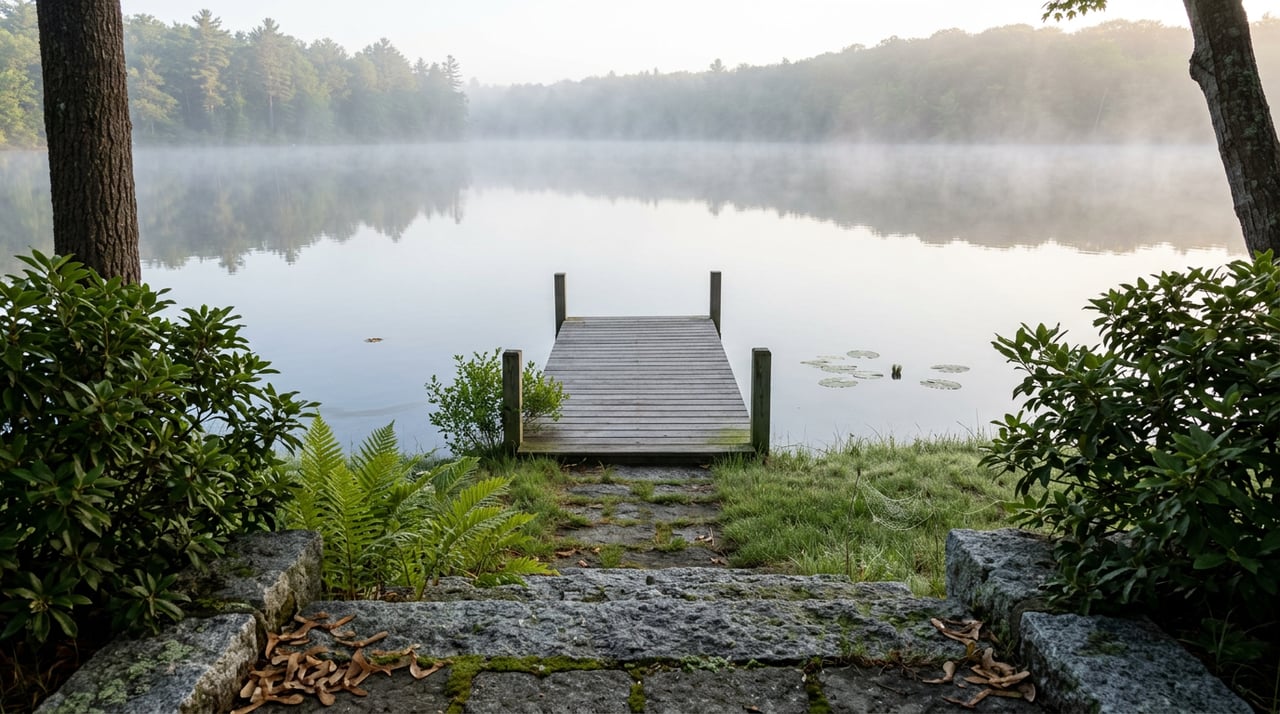
There is a gate on County Road with no sign. If you did not already know it marked the start of a trail, you would drive past it a hundred times without a second look. Follow the old cart path behind it for three-tenths of a mile, though, and the woods open onto a slight rise above the water, where a single picnic table sits at the edge of Messer Pond. No dock, no parking lot, no interpretive placard explaining what you are looking at. Just the pond, and whatever quiet you brought with you.
That gap between what the road tells you and what the water actually holds is the whole story of this pond. Messer Pond does not announce itself. It is worked on, quietly, by a small number of people who have decided that its stillness is worth maintaining rather than assuming.
The path is officially Trail #17 on the New London Conservation Commission's list, and the town's own trail guide describes it plainly: a cart path and woods trail across town land, ending at a rise on the shore with a picnic table at the water's edge. To find it, the direction most residents use is NH-114 to Parkside Road, then a left onto County Road, with parking along the shoulder after about nine-tenths of a mile.
It is not a hike in any showy sense. It is closer to the walk you take on a Tuesday evening because you have twenty minutes and want to see water. That modesty is deliberate. Messer Pond was never built for traffic, and the trail's lack of signage is less an oversight than a filter. The people who use it already know where it goes.
Messer Pond, as its own protective association describes it, covers 67 acres tucked between Bog Road and County Road, with roughly 50 families living around its shore. That is a small number for a body of water with a full-time volunteer organization behind it. The Messer Pond Protective Association was founded in 1996 and incorporated the following year, which means it has been running for three decades now on a resident base that could fit in a single large event hall.
New London does not treat this as unusual. According to the town's own materials, there are five active protective associations covering its lakes and ponds: Lake Sunapee, Little Lake Sunapee, Messer Pond, Otter Pond, and Pleasant Lake. Messer Pond is the smallest of that group by a wide margin, and it still gets the same structure of governance, the same volunteer labor, the same annual accounting that the much larger lakes receive. Size does not exempt a pond from stewardship here. It just means fewer hands doing the same list of jobs.
The association's own program list reads less like a lake club newsletter and more like an operations calendar:
None of these are visible from the picnic table at the end of Trail #17. You will not see a water sample being drawn or a weed patrol logging a find. What you experience as calm water and clean shoreline is the accumulated result of a checklist that a few dozen households have chosen to keep running every year since the mid-1990s.
The public boat launch sits at the pond's outlet on Bog Road, and it is not simply open water access. Under the state's Lake Host framework, the launch is staffed with paid and volunteer hosts from Memorial Day weekend through Labor Day weekend, offering free boat inspections aimed at catching invasive species before they hitch a ride from one waterbody to the next. Anyone launching a canoe or kayak from that outlet during peak season is passing, whether they notice it or not, through a checkpoint built specifically to keep Messer Pond from picking up what other lakes already carry.
The same stretch of shoreline near the outlet doubles as a modest birding spot, with marsh grass, riparian woodland, and open channels that draw activity from the shoreline to the canopy. It is the kind of detail that rewards a slow paddle rather than a fast one. Ducks, herons, turtles, otters, and beavers all show up in the association's own account of the pond's wildlife, which tracks with what a quiet morning on the water tends to produce if you are patient enough to sit still.
In recent years, the association's own calendar has listed its Annual Meeting for August 16, from 10 a.m. to noon, at the Tracy Library Community Room. There is no keynote speaker, no vendor booth, nothing that resembles a promotional event. It is a small nonprofit doing the paperwork of a small nonprofit: reviewing the year's water samples, checking in on the weed patrols, confirming who is available for the next Loon Count.
That kind of meeting is easy to overlook precisely because it asks for so little from the people who do not attend. But it is also the clearest evidence of how this pond actually functions. The quiet you notice from the trail or the picnic table is not a natural default state. It is a line item, decided on in a library meeting room, carried out across a summer by volunteers, and renewed every August whether or not anyone outside the watershed ever hears about it.
Compare Messer Pond to its four sibling associations in New London and the pattern holds across all of them: a lake that seems to run on its own is, in every case, being run by someone. What sets Messer Pond apart is the ratio. Fifty families supporting five active programs and a standing boat launch staffing schedule is a heavier lift per household than the town's larger lakes carry. The smallness of the pond does not reduce the workload. If anything, it concentrates it.
For anyone who already lives on or near Messer Pond, this is worth sitting with the next time the water looks unusually still. That stillness has a maintenance schedule behind it, kept by neighbors whose names you may never learn unless you show up to the meeting at the Tracy Library or take a shift at the Bog Road launch. The pond rewards attention, but the attention that keeps it this way was already spent, by someone else, before you arrived.
Messer Pond's quiet is the product of decades of small, specific choices made by the people who live around it, which is exactly the kind of local detail that matters when the time comes to understand a property here in full context. If you are weighing a move on Messer Pond, or anywhere in the Lake Sunapee region, Pamela Perkins can walk you through what that context actually means for a specific shoreline, a specific parcel, and a specific season. Get in touch to start that conversation.
Discover additional insights, market perspectives, and curated real estate guidance.


With generational ties to Lake Sunapee and a record that defines the New Hampshire luxury market, Pam Perkins represents a level of knowledge, discretion, and performance that few can match. Her clients trust her not only because of what she’s sold — but because of what she knows.
Connect with New Hampshire’s Top Broker